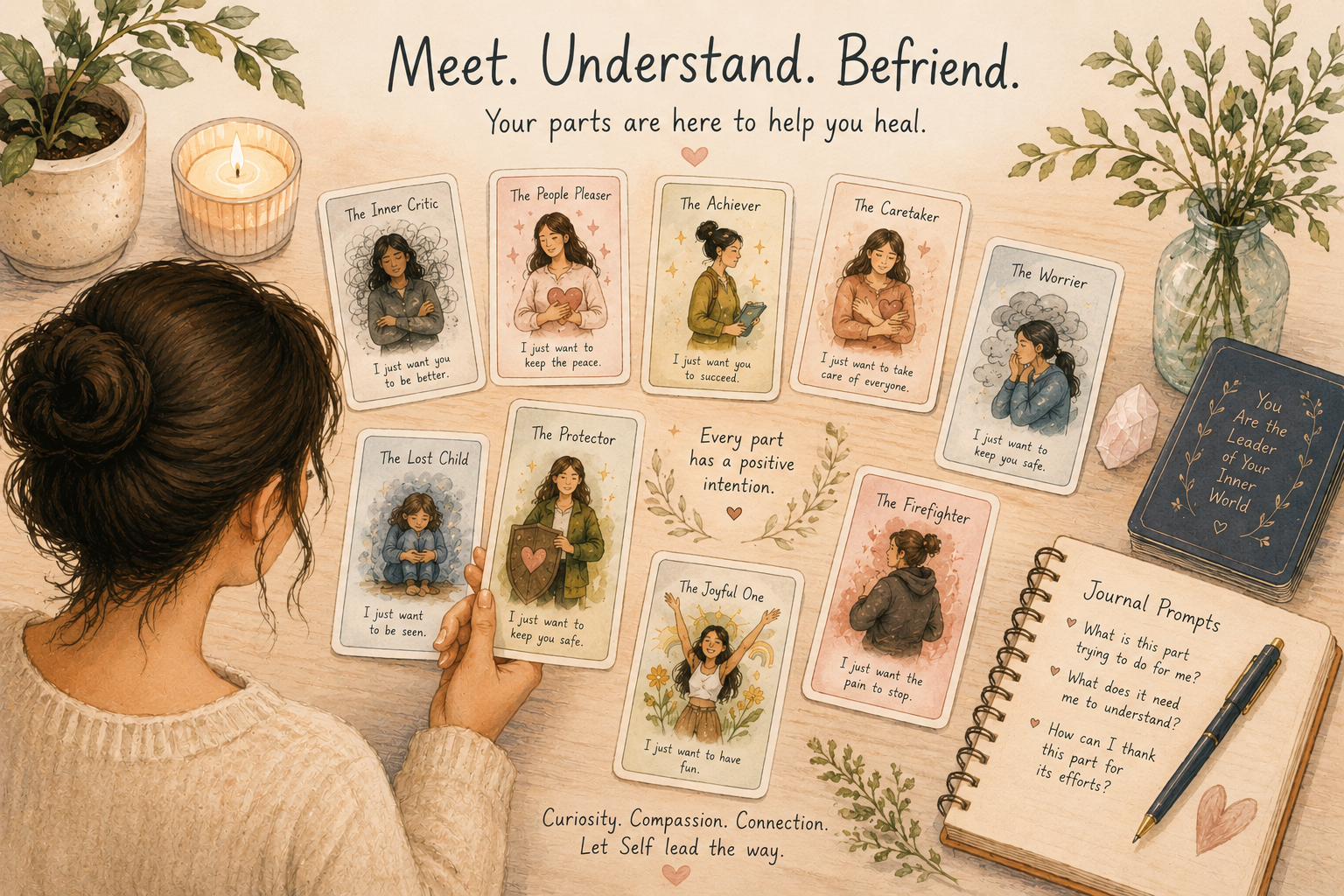
Welcome to your IFS Parts Cards — a reflective tool designed to help you explore your inner world with curiosity, compassion, creativity, and Self-leadership.
These cards are inspired by Internal Family Systems (IFS), a model that views the mind as made up of many "parts," each with its own feelings, beliefs, roles, fears, and protective intentions. These cards can help you identify, understand, and build relationships with your parts through journaling, visualization, therapy, coaching, groups, and creative self-reflection.
There is no perfect way to use them. Let your curiosity lead.
1. Shuffle the deck.
2. Set an intention or ask a question.
3. Pull one or more cards.
4. Notice what resonates.
5. Reflect, journal, draw, or discuss what comes up.
You may choose a card intentionally or pull one at random, similar to the way someone might pull an oracle or tarot card — not to predict the future, but to invite deeper self-awareness.
When working with parts, try to approach each one with curiosity rather than judgment.
Remember:
These cards are for reflection, education, and personal growth. They are not a replacement for therapy or mental health treatment.
Pull one card at random and ask:
Journal prompt: "Today, my __________ part wants me to know…"
Use this as a grounding practice at the start of the day. Ask:
Write one sentence of intention: "Today, I will notice my anxious part with gentleness instead of frustration."
At the end of the day, pull a card and reflect:
When you feel activated, scattered, or unsure what is happening internally, spread the cards out and ask: "Who is here right now?" Choose the card that feels most connected to your current experience. Then ask:
Use the cards similarly to an oracle or tarot-style spread — not to predict the future, but to reveal inner dynamics. Try this six-card spread:
Pull 3–7 cards and arrange them on a table. Notice which parts seem close together, opposed, loudest, hidden, tired, or protective of another part. Move the cards until the layout feels accurate — creating a visual map of your internal system.
Select cards representing different parts — the achiever, the critic, the caretaker, the perfectionist, the avoider, the anxious part, the angry part, the playful part, the wounded part, the wise part. Arrange them like a family photo and ask: Who is in the center? Who is pushed to the side? Who carries the most responsibility? Who rarely gets listened to?
Choose a situation you're struggling with (conflict, decision, procrastination, burnout, anxiety). Pull cards to represent the parts involved and ask which parts want to act, avoid, fear, get angry, or keep you safe. This reveals inner conflicts and polarizations.
When facing a decision, pull five cards:
Think about a recent moment when you felt triggered. Pull cards for: the part that got activated, the protector that stepped in, the vulnerable part underneath, the fear or belief being carried, and the Self-energy needed now.
Think of an important relationship and choose cards for: the part that shows up most often, the part that feels hurt or rejected, the part that protects you, the part that longs for closeness, the part that fears conflict, the part that wants to speak honestly. Ask: Which parts take over? What does each part need? How can Self lead?
Choose one card and close your eyes. Imagine this part as a character, image, color, shape, animal, child, object, or energy. Ask internally: What do you look like? How old do you feel? Where do you live inside me? What are you carrying? What do you want me to know? What do you need? Afterward, journal or sketch what you saw.
Use the card as inspiration. Draw the part's face, body posture, protective armor, environment, what it fears, what it longs for, or what healing might look like. This is not about artistic skill — it's about building relationship.
Choose a card and write a conversation between you and the part, Self and the part, two conflicting parts, or a protector and a vulnerable part. Ask: What are you trying to do for me? How long have you had this job? What are you afraid would happen if you stopped? What do you need?
Pull 3–5 cards and create a story. Who are the characters? What does each part want? What conflict are they facing? What happens when Self enters the story? What ending feels healing? Especially useful for creative writers, therapists, educators, and group facilitators.
Choose cards representing parts from different life stages — a childhood part, a teenage part, a young adult part, a current protector, a recently emerged part, a part ready for healing. Place them in chronological order and reflect on how your inner system has adapted over time.
Pull a card and notice where that part lives in the body — chest, throat, stomach, shoulders, jaw, head. Is it tight, heavy, numb, warm, restless, or buzzing? Does it have a color, shape, or texture? What happens when you breathe gently toward it?
In therapy, coaching, workshops, classrooms, or groups: invite each person to choose a card representing how they feel today, a part they're learning to understand, a protector they appreciate, a part they often judge, a part that needs compassion, or a strength they're reclaiming. Participants may share as much or as little as they choose.
Each person chooses: a part that shows up during conflict, a part that wants connection, a part that feels misunderstood, a part that protects from vulnerability, a part that wants to be seen. Use "part language" to soften blame:
Instead of: "You never listen."
Try: "A part of me feels unheard and starts to protect me by shutting down."
Pull a card and write from that part's voice:
Choose cards representing parts you want to understand better, parts seeking healing, strengths to cultivate, qualities of Self you want to embody, and a new relationship you want to build with yourself. Add images, colors, words, symbols, and affirmations.
At the start of each month, pull 3–5 cards. Record which parts appeared, what themes they represent, what they may need this month, what you want to practice, and what you notice by month's end. Over time, this reveals meaningful patterns.
Choose a card representing a part that feels intense. Before engaging with it, pause and ask: Can I feel curiosity toward this part? Compassion? Can I give it space? Can I listen without trying to fix it? If you cannot access compassion, notice whether another part is judging or resisting — that part may need attention first.
Choose a card representing a protective part. Write or say: "Thank you for trying to protect me. I want to understand you better." Then ask: What job have you been doing? When did you learn this role? What are you afraid would happen without you? What do you wish I understood? What support would help you soften?
Choose a card representing a younger, tender, ashamed, lonely, or wounded part. Move slowly. Ask what this part needs to feel safe — closeness, space, comfort, protection, or witnessing. What does it want you to know? If this feels too intense, pause and seek support from a therapist or trusted professional.
What part needs my attention today?
Use for daily check-ins, journaling, and grounding.
Use these with any card:
These cards are intended for self-reflection, personal growth, education, and creative exploration. They are not a substitute for therapy, diagnosis, or mental health treatment.
If a card or exercise brings up intense emotions, trauma memories, urges to harm yourself or others, or feelings that become overwhelming, pause the exercise and seek support from a licensed mental health professional, crisis resource, or trusted support person.
Move at the pace of your nervous system. You do not have to explore everything at once.
Your parts are not problems to solve.
They are relationships to build.
Let these cards be invitations into curiosity, compassion, creativity, and deeper connection with yourself.
← Back to Wellness & Co